Following ChatGPT’s debut in 2022, every major tech giant has shown interest in a piece of the AI pie. Generative AI has become so popular, in fact, that it has become practically unavoidable in day-to-day life, holding the potential to become the most significant technological leap for humanity in the last decade.
However, not everything is sunshine and rainbows in the world of AI. Between its many drawbacks and inconsistencies, artificial intelligence is still very much a work in progress. This progress also comes at a cost, and a major one at that.
Global memory prices have suddenly begun to soar, and the situation is so bad that the general consumer is practically helpless today. We can thank companies like OpenAI for this situation, and the sad part is that this is just the beginning. Looking forward to 2026 and beyond, AI investments and global price hikes could do irrepairable harm to the gaming industry.
RAM And SSD Shortages Are Upon Us
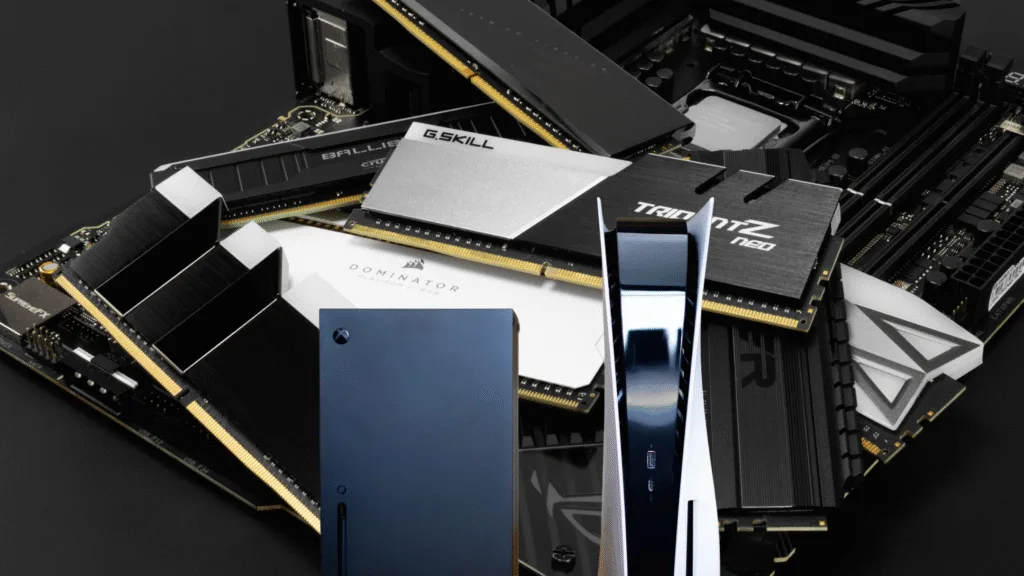
RAM and SSD pricing were the least of anybody’s concern until a few months ago. In a mere two months, however, prices of DDR5 memory have more than quadrupled.
To put things into perspective, Samsung is said to have raised both DDR4 and DDR5 contract prices by over 100%. Elsewhere, a major supplier like Micron recently confirmed the closure of Crucial, its consumer-focused memory and SSD brand.
This is problematic since Samsung, Micron, and SK Hynix manufacture most of the world’s memory and storage supply. All three are now shifting focus toward HBM (High Bandwidth Memory), used for data centers.

Ahead of these price hikes, OpenAI announced a major deal with Samsung and SK Hynix for project Stargate. This deal effectively entails the company securing 900,000 DRAM wafer starts per month for its AI endeavors, an amount said to roughly equal 40% of the world’s current supply.
For context, Tech Insights reports that global fab capacity was around 10 million wafer starts per month. Although OpenAI’s 40% percentage share may be hyperbole, it represents the severity of the demand for HBM memory. As IGN reports, a company like Micron expects current supply constraints and demand to last well into 2026.
This chart, put together by ARS Technica, shows just how grave the situation is. 32GB of T-Force Vulcan DDR5-6000 memory, which used to cost $82 in August 2025, is now priced at over $340.
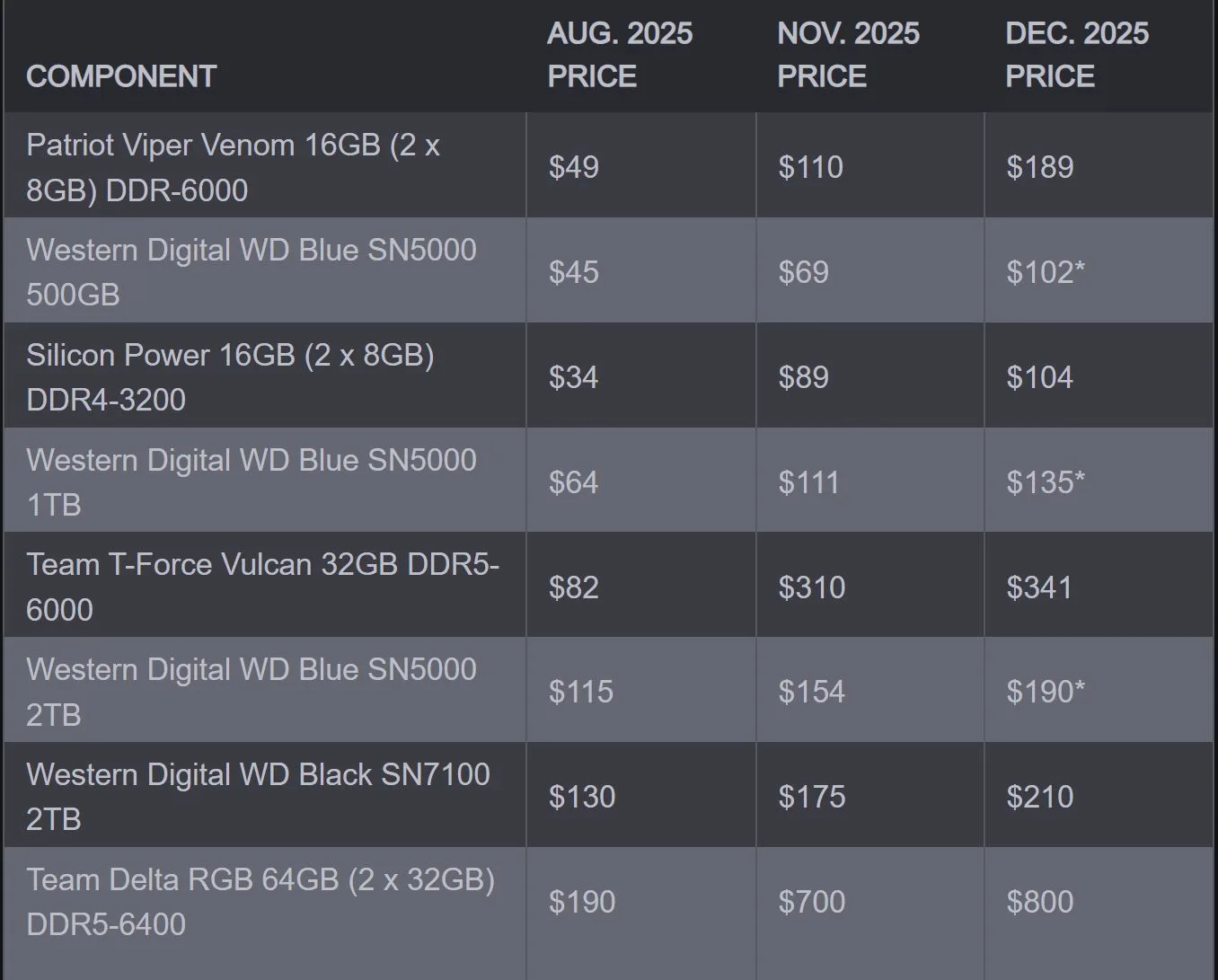
The situation is so bad that a company like G.Skill has come forward with a public statement declaring AI demand responsible for the higher cost from IC suppliers.
Impact On Consoles And Gaming Will Be Huge
Needless to say, all of these price hikes and supply limitations could have long-term consequences on the entire gaming industry. For consoles, the situation seems particularly dire since both the PS5 and Xbox Series S|X have seen multiple price hikes over the last few months amid the US tariffs.
PlayStation CFO Lin Tao previously acknowledged that rising memory prices would hurt the profitability of its hardware. On the other hand, Nintendo seems confident that it can maintain current levels of profitability for a good while.
Reports like TrendForce’s add to the concerns, which state that 2026 shipment forecasts have already been downgraded by up to 5%. This is especially alarming since analysis shows that US spending on consoles in November reached an all-time low of just 1.6 million sales.
New analysis from Reuters also shows that console prices could rise between 10% to 15% in in the next two years. Even the next-generation hardware is likely to start from $600 due to the uncertainty surrounding DRAM and NAND pricing.
PC Gaming Should Brace for Impact
Where does PC gaming fit into this conversation? As one would expect, PC gaming will have it worse than the consoles. Consumer-grade DDR5 and DDR4 have effectively become so expensive that 64GB of DDR5 now costs more than a PS5 Pro, so all sorts of PC builds will be a lot more expensive in the future.
Memory prices could see another 30% hike next year, making PC building even more expensive. However, this is far from all PC gamers have to look out for. GDDR7 memory, used across both Nvidia and AMD graphics cards, will become another limiting factor in this equation.
PC builders can expect to pay a premium on graphics cards, RAM, and SSDs next year. Effectively, this will mean that the ideal $1000-1200 PC will be impossible to build next year. According to IDC, even OEMs like Dell, Lenovo, and HP expect prices to rise by around 20%.
On average, the prices could rise by 4-6%. If this wasn’t bad enough, OEMs will continue to sell PCs without memory in 2026, something they just started doing after recent events.
Steam Machine
Valve’s Steam Machine holds the promise to bridge the gap between the appeal of PC gaming and the simplicity of console gaming. Despite the excitement surrounding this hardware, pricing remains a major point of contention, especially since Valve has yet to comment on the matter.
The Steam Machine is currently expected to cost around $700, but there’s a catch. The ongoing memory crisis could throw a wrench in Valve’s plans since the PC-console hybrid hardware is expected to launch in 2026, and prices are only expected to go up in the coming months.
Even if Valve has secured enough inventory for several million Steam Machine units, the reality is that RAM and NAND prices are not coming down anytime soon. This means that Valve might be forced to make the difficult choice to raise the price of the Steam Machine or possibly delay the hardware.
In the worst case scenario, this might ruin what could have otherwise been Valve’s most successful hardware endeavor to date.
What About Smartphones And Laptops?
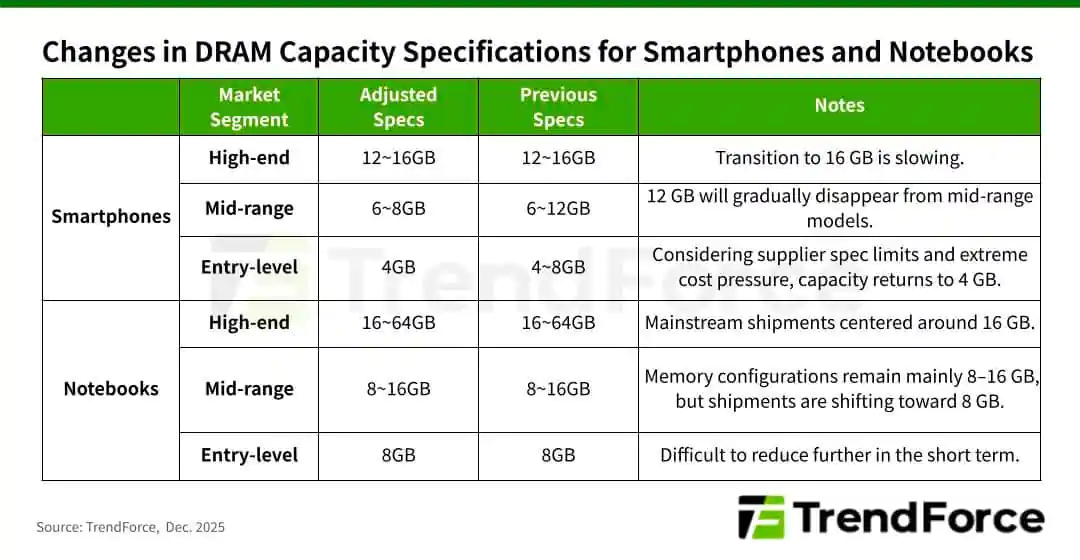
The sad part is that the global focus on AI applications means that even smartphones and laptops will suffer in the short-term. In particular, TrendForce expects smartphones to revert to 4GB of memory in the budget category and 8GB of memory for higher-end offerings.
As for laptops, 8GB of memory could become the standard yet again. This is a massive downgrade, considering 16GB of memory was the norm for laptops until recently, and phones offered as much as 12GB of RAM at the top end.
AI Detox
As miserable as the situation seems for now, all hope is not lost. With just a few quick steps, we can significantly limit our exposure to AI content, thereby contributing to a potential boycott.
Recently, apps like Pinterest have given users the option to toggle generative AI content on and off. While the likes of Google don’t offer a similar option to disable AI search results, this is something many users have called for as well.
This solid guide on PumpkinMayo shows a potential solution to disabling AI search results on Google using udm14. Similarly, using specific rules for filters in extensions like UBlock Origin can prevent Google from presenting its often inaccurate AI search results.

For those using a browser like Brave, disabling multiple AI elements is a single click away. Of course, these steps don’t solve the problem entirely, but they do at least eliminate constant exposure to low-quality AI search results on Google.
For most people, switching to a different search engine isn’t really an option, so this is the next best option for now.
Raising Voices Against AI In Games And Other Places
This is something many in the games industry are already doing. Recently, a game like Clair Obscur: Expedition 33 suffered major consequences for the slightest hint of AI use when it was stripped of its Game of the Year at the Indie Game Awards.
Similarly, games like Black Ops 7 were widely criticized when gamers found out that much of the art used in the title was AI-generated. Even Battlefield 6 came under fire when players noticed a single instance of art made from generative AI.
However, I believe the gaming industry isn’t doing enough. Executives at the top level won’t care much until they see substantial pushback against artificial intelligence. This can only be done through a focused effort and potential boycott when it comes to games using generative AI.
This is easier said than done since future games will likely rely heavily on artificial intelligence, but the gaming industry has voted with its wallet in the past. In my opinion, any instance of generative AI, particularly for artistic purposes, should be considered an immediate red flag, leading to a major boycott.
Creating General Awareness
Ultimately, creating awareness regarding AI and its net negatives is important for everyone. Recently, Twitter users have noted that the platform now makes it easier than ever to edit images with AI, something that can’t be simply toggled off.
It’s important we spread such messaging to the general public. Within the context of gaming, enthusiast audiences can help more casual gamers understand the negative implications of AI use. It’s also important to keep an eye out for AI disclaimers on platforms like Steam.
Platforms like Windows have received considerable pushback for essentially forcing AI features on users who may not be particularly interested in the technology, and this type of criticism should not be silenced. If we hope to even limit the negative impacts of AI, we must do everything in our power to stop it from spreading further.