

Generative AI has been a hot topic in the gaming industry since its introduction. The debate has recently become quite controversial, with a game like Clair Obscur: Expedition 33 being eliminated from the Indie Game Awards following claims of Sandfall Interactive’s AI use during development.
Amid this controversy, then, it has become clear that many are not fond of generative AI and have taken a stance against it. In particular, the use of generative AI for artistic purposes is controversial, but one developer from the MultiVersus team believes there is nothing wrong with using the technology for image creation.
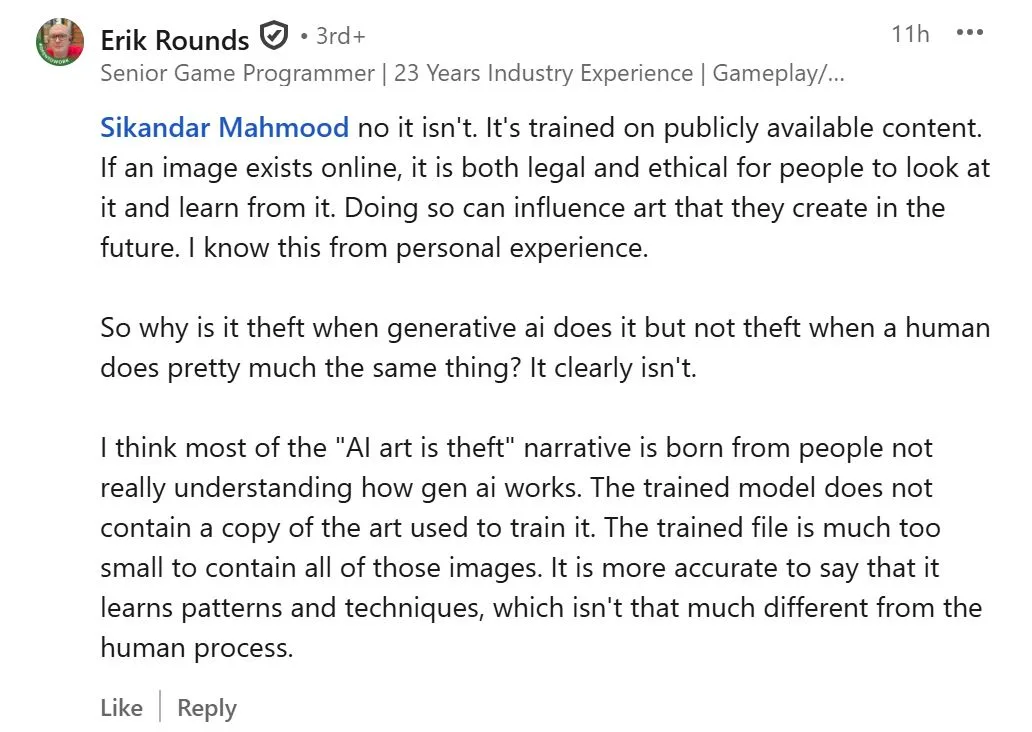
Erik Rounds, who worked on MultiVersus as an engineer, recently denied the argument that generative AI is trained on stolen content, and data from it is therefore considered theft.
In a comment on LinkedIn, the developer argues that since artificial intelligence simply uses data that is already available online for the public to see and use, it is completely ethical and legal for it to use this data. He also drew a comparison between generative AI and human artists.
Erik Rounds claims that since artists use already available images and data for inspiration, the same principle being applied to AI should be treated with no prejudice. The developer outlines that generative AI simply learns patterns and techniques from existing work instead of copying it.
“Why is it theft when generative AI does it, but not theft when a human does pretty much the same thing? It clearly isn’t. The trained model does not contain a copy of the art used to train it. It is more accurate to say that it learns patterns and techniques, which isn’t much different from the human process” -Erik Rounds
To nobody’s surprise, this response led to some people disagreeing with Erik Rounds. Indie artist Helmut Schulz discussed how the subject of ownership is a delicate matter when it comes to content created by generative AI.
Given Erik Rounds’ opinion on the matter, it comes as no surprise that the gaming industry is moving forward with a huge focus on artificial intelligence. The technology is also quite lucrative for shareholders and upper executives looking to improve margins by cutting costs where possible. However, the debatability of generative AI’s morality will certainly live on for many years to come.





Global India Pharmacy: Global India Pharmacy – Global India Pharmacy