Motion sickness is one of the most common issues associated with games today. As modern titles become more fast-paced and frenetic, they can often lead to motion sickness, particularly when these types of movements are combined with first-person perspectives and narrow field of views.
Although there are certainly ways to reduce the amount of motion sickness that affects the average fan today, there is no definitive solution to this issue. However, Sony’s latest patent could hint at a potential stride toward solving motion sickness.
As discovered by the Clawsomegamer team, Sony has filed a patent for detecting the onset of motion sickness before it first shows up to ensure players can take the necessary steps to avoid the issue altogether.
Sony’s patent was published on 27th November and describes a system where a game console camera is used to analyze player motions.
The patent points to changes in posture stability as a precursor to motion sickness. Relying on the camera, the patent effectively describes a system where players are monitored over time or during a short window. When deemed adequate, the monitored footage can then lead to an advisory image or message warning of motion sickness.
Sony points out that this patent would work not only for symptoms onset by traditional games, but also in cases where VR headsets are involved. This is important since this type of experience typically leads to more instances of motion sickness.
A more advanced setup of the same patent could also employ AI for a machine learning model that could do the job of presenting the advisory. Moreover, this advisory could be followed by recommended changes to game settings, including FOV and frame-rate adjustments.
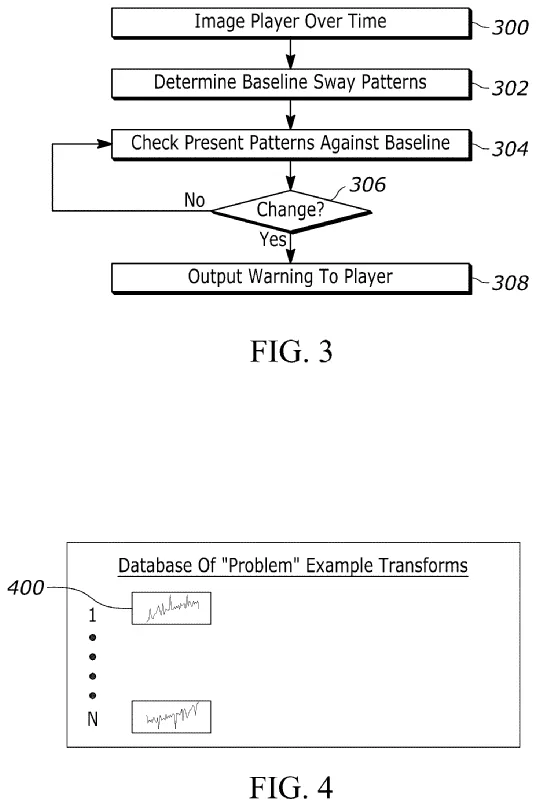
According to the patent, these adjustments could be made manually or automatically. A basic flowchart representing how the model would work is shown above in Figure 3. The same figure shows how the camera would image players over time and make a note of baseline sway patterns based on the player’s head or eye movements, and legs or arms.
Converting these to a graphical representation and then comparing with updated patterns, the system would determine whether the player should be presented with a warning. Figure 4 shows a potential Fourier transform to represent motion over time.
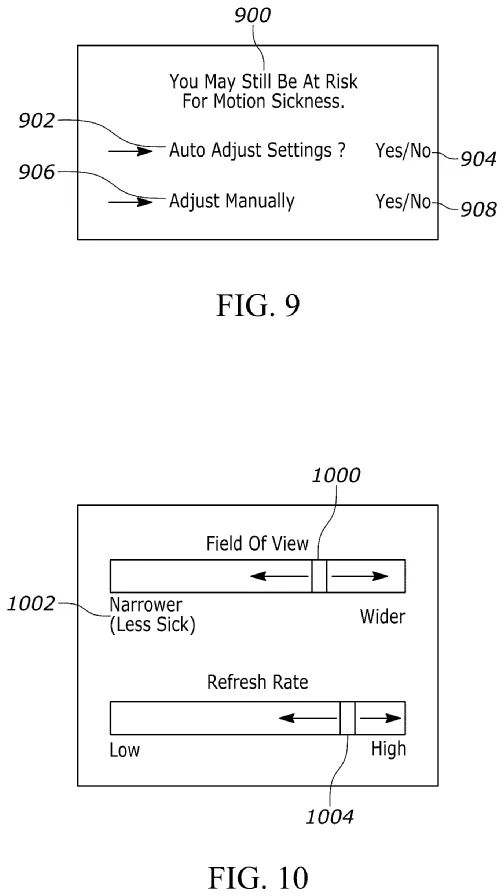
The implementation of potential solutions in this system is represented above in Figures 9 and 10, where a machine learning model could offer automatic adjustments or present the user with the choice to change settings manually.
While this solution would not completely solve the problem, nor would it eliminate motion sickness from games altogether, it would certainly make the gameplay experience a lot more bearable for those susceptible to the problem.
Some gamers might also be apprehensive about constant monitoring from a camera, but the trade-off may be worth it in certain cases.